
Nov 27th, 2026
FERIT at CoLab symposium in Częstochowa: battery systems for renewable integration
From 25 to 27 November 2026, the scientific symposium “CoLab on Challenges Related to Renewable Energy Sources in the Era of Fossil Fuels” took place in a hybrid format, on-site in Częstochowa, Poland (at BLAZE HARMONY) and online via Zoom. Organised by Jan Długosz University in Częstochowa and the COLOURS European University Alliance, the event covered renewable energy integration (including biomethane, green hydrogen, biomass, solar and battery storage), industrial field visits to the CEMEX cement plant and the Agro-Biogas plant, and the legal and policy barriers to the energy transition.
Date
25–27 November 2026
Location
Częstochowa and online
Speaker
Prof. Danijel Topić, FERIT
Session
Session III, 25 November
On the programme
Renewables
Biomethane, green hydrogen, biomass, solar and battery storage
Field visits
The CEMEX cement plant and the Agro-Biogas plant
Law and policy
Legal and policy barriers to the energy transition
Why storage matters
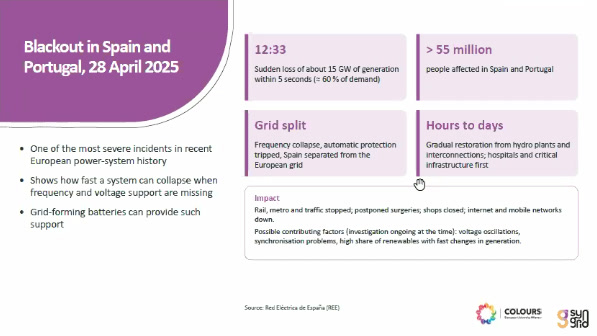
50 Hz
grid frequency that has to be kept
15 GW
generation lost within 5 seconds on 28 April 2025
55M+
people affected in Spain and Portugal
≈60%
of demand covered by the lost generation
In Session III on 25 November, Prof. Danijel Topić (the Faculty of Electrical Engineering, Computer Science and Information Technology Osijek) presented “Battery systems for better integration of renewable energy sources into the power system”. He explained that variable renewable generation from solar and wind needs millisecond-fast flexibility to keep grid frequency at 50 Hz and prevent large-scale blackouts, such as the April 2025 Iberian Peninsula grid collapse, which affected more than 55 million people.
A fast-growing market
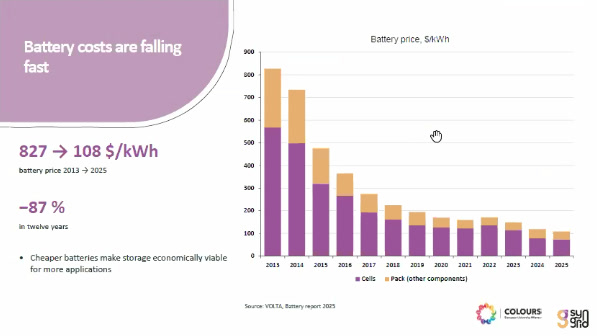
−87%
drop in battery costs
$108
per kWh: battery cost in 2025
26.4 GW
grid-scale storage worldwide
90%+
market share of lithium-ion
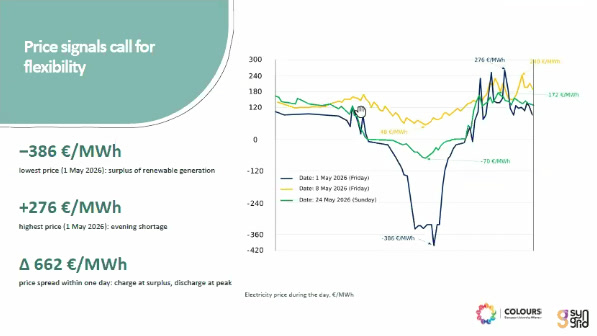
An 87% drop in battery costs (to $108/kWh in 2025) and wide intraday electricity price spreads (up to €662/MWh) have driven rapid growth in grid-scale storage, now at 26.4 GW globally. Lithium-ion technology holds more than 90% of the market, supported by modern SiC and AI-controlled inverters.
Grid-forming batteries
Prof. Topić stressed that the shift to grid-forming batteries is crucial. Unlike standard grid-following units, grid-forming systems set their own voltage and frequency references, which allows them to support weak grids and run islanded microgrids as conventional fossil-fuel power plants are phased out.
Grid-following
Inject energy only into an existing, stable grid
Cannot operate alone during a blackout without another source
Used by most large battery power conversion systems today
Grid-forming
Behave as grid-following in normal conditions
Create their own voltage and frequency reference when the grid fails
Operate grid-connected and islanded: microgrids, critical infrastructure
Key messages
Balance
Variable renewables need flexibility; batteries respond in milliseconds.
Economics
Falling costs and large price spreads make storage viable.
Technology
Li-ion dominates; modern power conversion with SiC and AI control adds value.
Resilience
Grid-forming batteries support weak grids, islanded operation and critical infrastructure.
The presentation was also a contribution to the SynGRID project, in which FERIT is a partner.